The Mortgage Stress Test, Explained for First-Time Buyers
If you have started shopping for a mortgage, you may have noticed a strange gap: the rate your lender quotes you is not the rate they use to decide how much you can borrow. That gap is the mortgage stress test, and for a first-time buyer it is often the single biggest factor separating what you think you can afford from what a lender will actually approve. Here is how it works, what it looks like in real numbers, and where the rules have genuine flexibility.
What the stress test actually calculates
Every federally regulated lender, meaning every bank, has to qualify you at a rate higher than the one you will actually pay. For uninsured mortgages (a down payment of 20 percent or more), the Office of the Superintendent of Financial Institutions, the federal banking regulator, sets the qualifying rate at the greater of your contract rate plus 2 percentage points, or a fixed floor of 5.25 percent, unchanged since June 1, 2021, according to OSFI's minimum qualifying rate ruleand its 2021 letter setting that floor. The federal Department of Finance applies the same formula to insured mortgages (down payments under 20 percent), effective the same date, according to the Deputy Prime Minister and Minister of Finance's May 2021 statement on the Canadian housing market. Insured, uninsured, and uninsurable mortgages (homes at 1.5 million dollars or more, and refinances) are all tested against the same rule.
With rates where they sit today, the contract-rate-plus-2 side of that comparison binds for almost every borrower. Chartered banks' official posted 5-year conventional mortgage rate was 6.09 percent as of September 2, 2026, according to the Bank of Canada's posted interest rate data. A posted rate is a bank's official rate card, not the discounted rate most borrowers actually negotiate, but the math holds either way: add 2 points to any real-world contract rate and you clear the 5.25 percent floor comfortably, so your real qualifying rate is your own rate plus 2 points, not the floor itself.
What that gap looks like in dollars
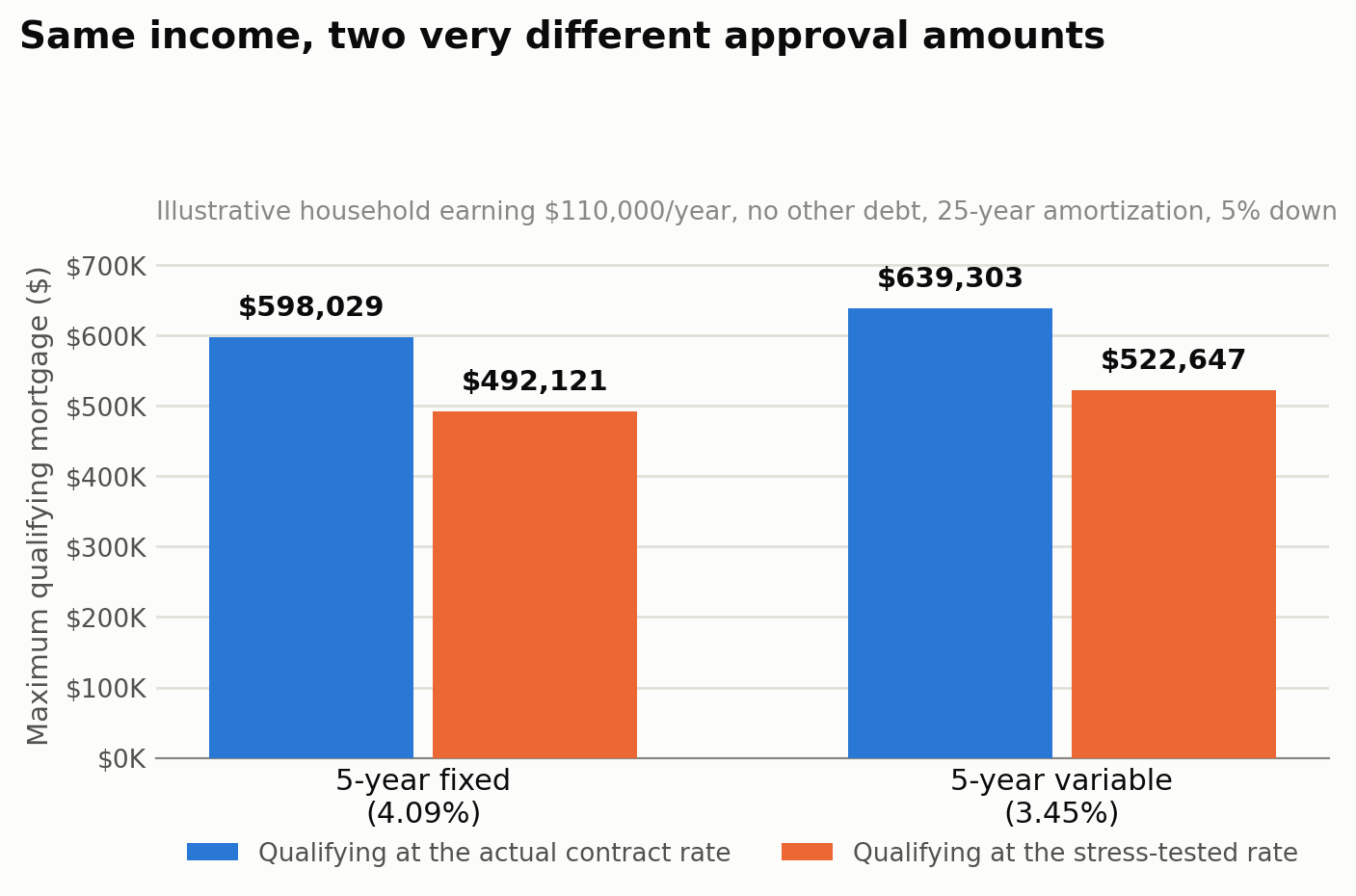
The chart above illustrates a hypothetical household earning 110,000 dollars a year, with no other debt payments, putting 5 percent down, and borrowing over a 25-year amortization. Using the gross debt service guideline lenders apply to insured mortgages (housing costs capped at 39 percent of gross income), that household would qualify for roughly 598,000 dollars at today's 4.09 percent fixed rate, but only about 492,000 dollars once the stress test is applied, a reduction of nearly 18 percent. The variable-rate version tells the same story: about 639,000 dollars at the actual 3.45 percent rate, down to about 523,000 dollars once stress-tested.
This is an illustration, not a quote. Your own numbers depend on your actual income, debts, credit, the property's condition, and your specific lender's underwriting, and only a mortgage professional can tell you what you would actually qualify for. What the example is meant to show is the scale of the effect: a two-point buffer on top of an already-elevated rate environment routinely cuts qualifying power by somewhere in the range of 15 to 20 percent, which is worth knowing before you start touring homes at the top of what you assumed your budget was.
The one exemption that actually matters right now
There is a genuine carve-out worth knowing about if you already own: since 2024, a borrower renewing their mortgage and switching to a different federally regulated lender no longer has to pass the stress test again, provided the loan amount and amortization stay the same. Before that change, the only way to shop your renewal to a better rate without re-qualifying was to stay with your existing lender, which weakened your negotiating position. That restriction is gone. It does not help first-time buyers taking out a new mortgage, but if you already own and are coming up on renewal, it means you can genuinely shop the whole market rather than being informally locked in.
Provincially regulated credit unions sit outside this system entirely, since OSFI's stress test is a federal rule. That does not mean an easier bar to clear: credit unions apply their own underwriting standards, which are typically just as disciplined, according to the Canadian Credit Union Association's comments to Global News. It is a different qualifying formula, not a shortcut.
The other lever: amortization length
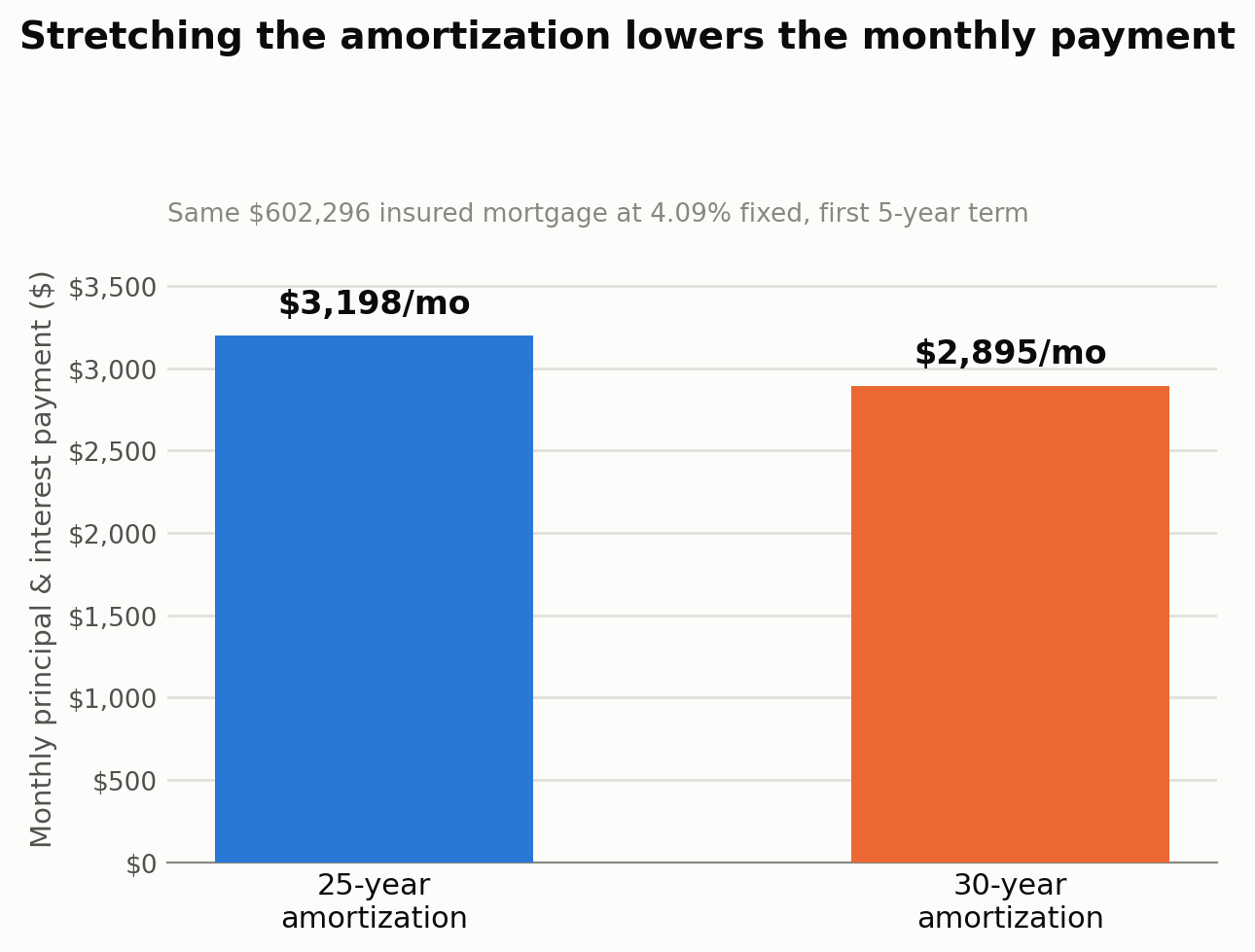
Since December 15, 2024, first-time buyers with an insured mortgage can amortize over 30 years instead of 25, on homes priced up to 1.5 million dollars, according to Ratehub's coverage of the reform. The effect on your monthly payment, and therefore on what you can qualify for, is meaningful. On a 602,296 dollar mortgage at 4.09 percent fixed, Ratehub's own calculation shows the payment drops from 3,198 dollars a month at 25 years to 2,895 dollars at 30 years, a difference of 303 dollars every month. The tradeoff is that you pay more interest over time and build equity more slowly in the early years, so it is a genuine decision, not a free upgrade, but for a buyer who is qualifying-constrained rather than payment-constrained, it can be the difference between qualifying and not.
What this means for your search
None of this changes what a home actually costs. It changes what a lender will let you borrow to buy one, which is a different constraint and one that catches a lot of first-time buyers off guard partway through a pre-approval conversation. Two things are worth doing before you start touring homes seriously: ask your mortgage broker or lender to show you the stress-tested number, not just the rate you would pay, and ask specifically whether you qualify for the 30-year amortization if your down payment is under 20 percent. Both take a few minutes and can materially change your price range.
If you would like a referral to a mortgage broker to work through your own numbers, or want to talk through how this affects your search in Metro Vancouver specifically, get in touch directly.