Down Payment Programs Available to First-Time Buyers in BC Right Now
Saving a down payment is the part of buying a first home that discourages people before they even start looking. It doesn't help that a lot of the advice circulating online is outdated, pointing to programs that no longer exist or missing rule changes from the past two years. Here is what is actually available to a first-time buyer in British Columbia today, what each program is worth in real dollars, and what it does not do.
Two federal accounts you can stack together
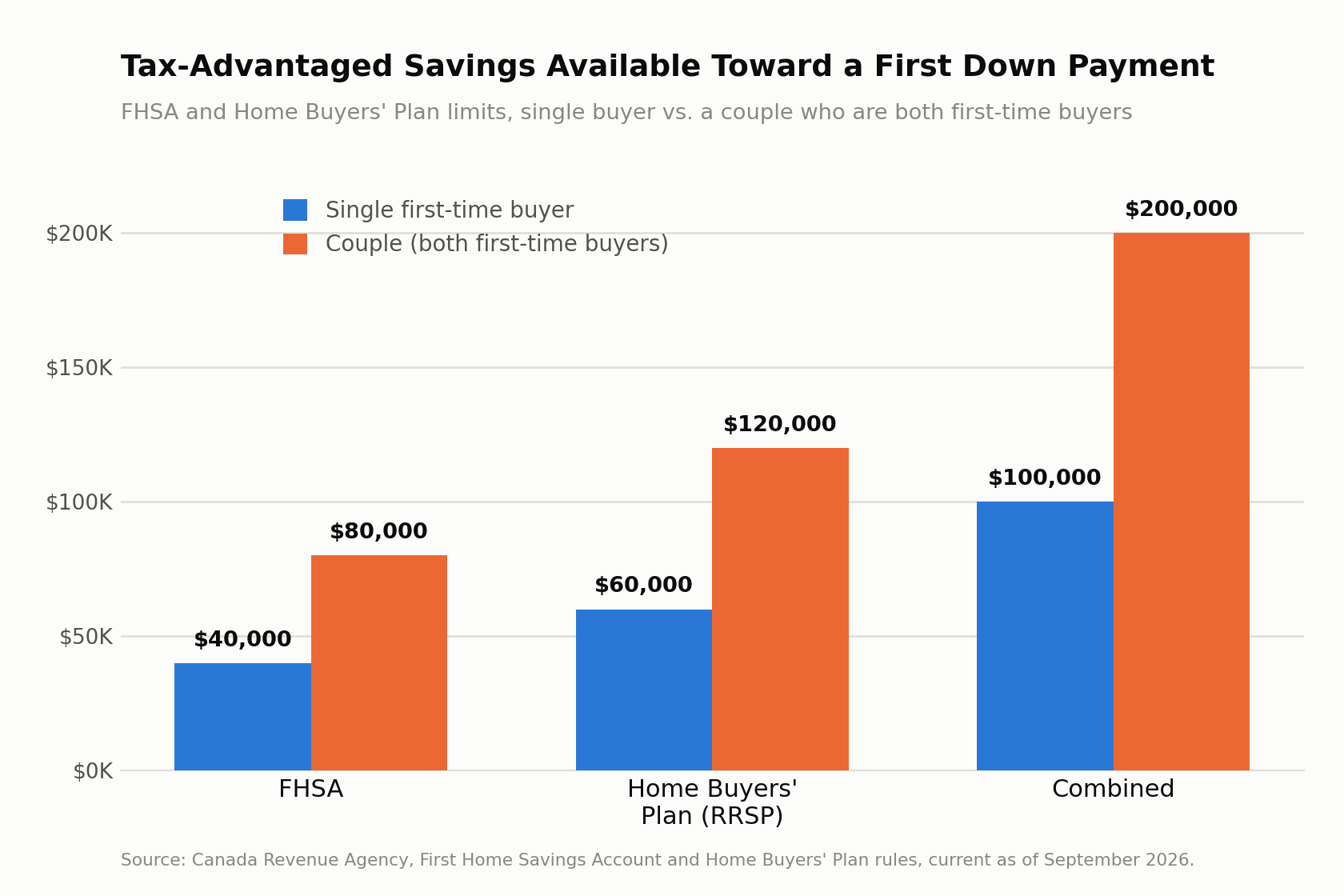
The two federal programs that matter most today are the First Home Savings Account and the Home Buyers' Plan, and the useful thing about them is that they stack.
The First Home Savings Account, or FHSA, lets a first-time buyer contribute up to $8,000 a year toward a home purchase, up to a $40,000 lifetime limit, according to the Canada Revenue Agency's FHSA rules. Contributions are tax-deductible like an RRSP contribution, and a withdrawal for a qualifying first home, including any investment growth inside the account, comes out completely tax-free. Unused room carries forward by one extra year at most, so a buyer who skipped 2025 has $16,000 of room in 2026, not the full $40,000.
The Home Buyers' Plan lets a first-time buyer withdraw up to $60,000 from an existing RRSP, tax-free, toward a first home, according to the CRA's Home Buyers' Plan rules. That limit rose from $35,000 on April 16, 2024. Unlike the FHSA, this is a loan from yourself: repayment into your RRSP happens over 15 years, one-fifteenth a year, starting the second year after the withdrawal. A missed payment gets added to that year's taxable income instead.
Together, a single first-time buyer can put up to $100,000 of tax-advantaged savings toward a down payment, and two first-time buyers purchasing together can reach $200,000 combined. Neither program is free money: the FHSA's annual cap takes years to fill, and the Home Buyers' Plan is a debt you owe yourself. But the combined ceiling is real, and well above where it sat two years ago.
The Home Buyers' tax credit
A first-time buyer can also claim the federal Home Buyers' Amount at tax time: up to $10,000 in eligible costs, worth up to $1,400 in actual tax savings at 2026's lowest federal rate of 14 percent, according to the CRA's Home Buyers' Amount guidance. It's a non-refundable credit, so it reduces tax owed rather than generating a refund, and it's claimed once, in the year you buy.
The provincial program that cuts a closing cost
BC's Property Transfer Tax applies to almost every purchase in the province: 1 percent on the first $200,000 of value, 2 percent on the portion between $200,000 and $2 million, and higher marginal rates above that. On a home at Metro Vancouver's August 2026 composite benchmark of $1,081,900, that works out to roughly $19,600 before any exemption, using the price from GVR's August 2026 market report.
The province's First Time Home Buyers' Program reduces or eliminates that tax for a qualifying buyer. A purchase with a fair market value of $835,000 or less gets the full benefit, up to $8,000, covering the tax on the first $500,000 of value. The benefit phases out between $835,000 and $860,000, and disappears above that. Eligibility generally requires Canadian citizenship or permanent residency, a year of BC residency (or BC tax returns filed in two of the past six years), never having owned a principal residence anywhere, and living in the home as your principal residence. This is the one program here that cuts a closing cost rather than helping you save, and it's worth confirming with your notary or lawyer, since the eligibility rules have more edge cases than the dollar thresholds suggest.
What this adds up to
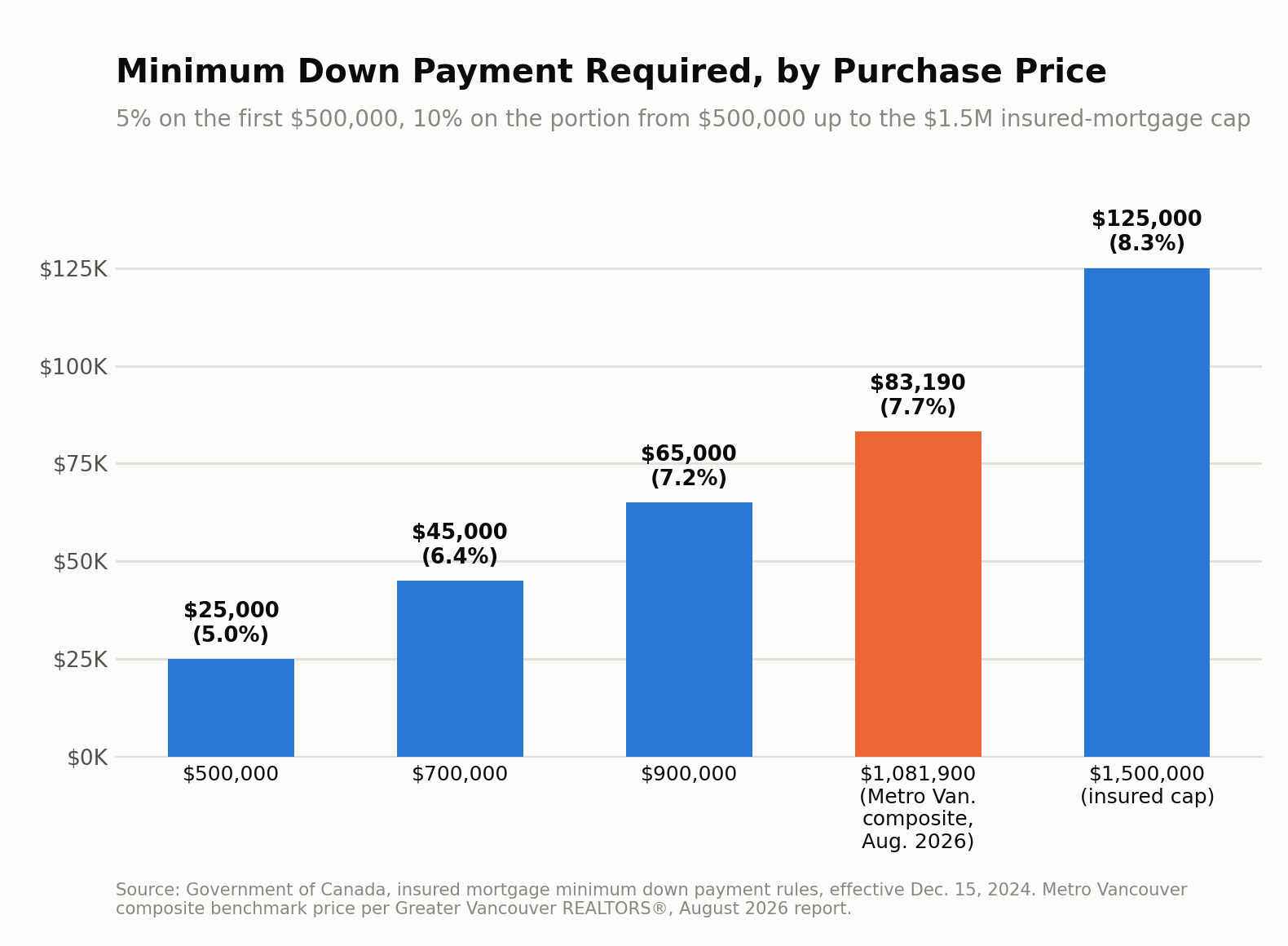
The down payment itself follows separate rules. For an insured mortgage, the minimum is 5 percent on the first $500,000 of price and 10 percent on the portion from $500,000 up to $1.5 million, a cap raised from $1 million on December 15, 2024. At Metro Vancouver's composite benchmark of $1,081,900, that's a minimum down payment of roughly $83,190, about 7.7 percent of price. At the region's $686,200 apartment benchmark, the minimum drops to roughly $34,310, both per GVR's August 2026 report.
A single buyer combining the FHSA and Home Buyers' Plan could realistically cover the minimum down payment on a typical Metro Vancouver apartment from tax-advantaged savings alone. A detached home at the region's benchmark price is a bigger stretch, since its minimum sits close to that $100,000 combined ceiling, which is where the tax credit and the PTT exemption start to matter even though they're smaller dollar amounts. Each program has its own eligibility rules rather than an income test, so it's worth checking all of them against your own situation.
Where to start
None of this replaces a conversation with a mortgage broker about your own numbers, and the FHSA in particular works best started years before you buy, not the month you start touring homes. If that's you, opening one now, even with a small first contribution, locks in room you'd otherwise lose.
As a REALTOR® with Oakwyn Realty working mainly with first-time buyers, I walk clients through exactly this kind of program stacking regularly. If you would like a referral to a mortgage broker, or want to talk through your own timeline and eligibility, get in touch directly.